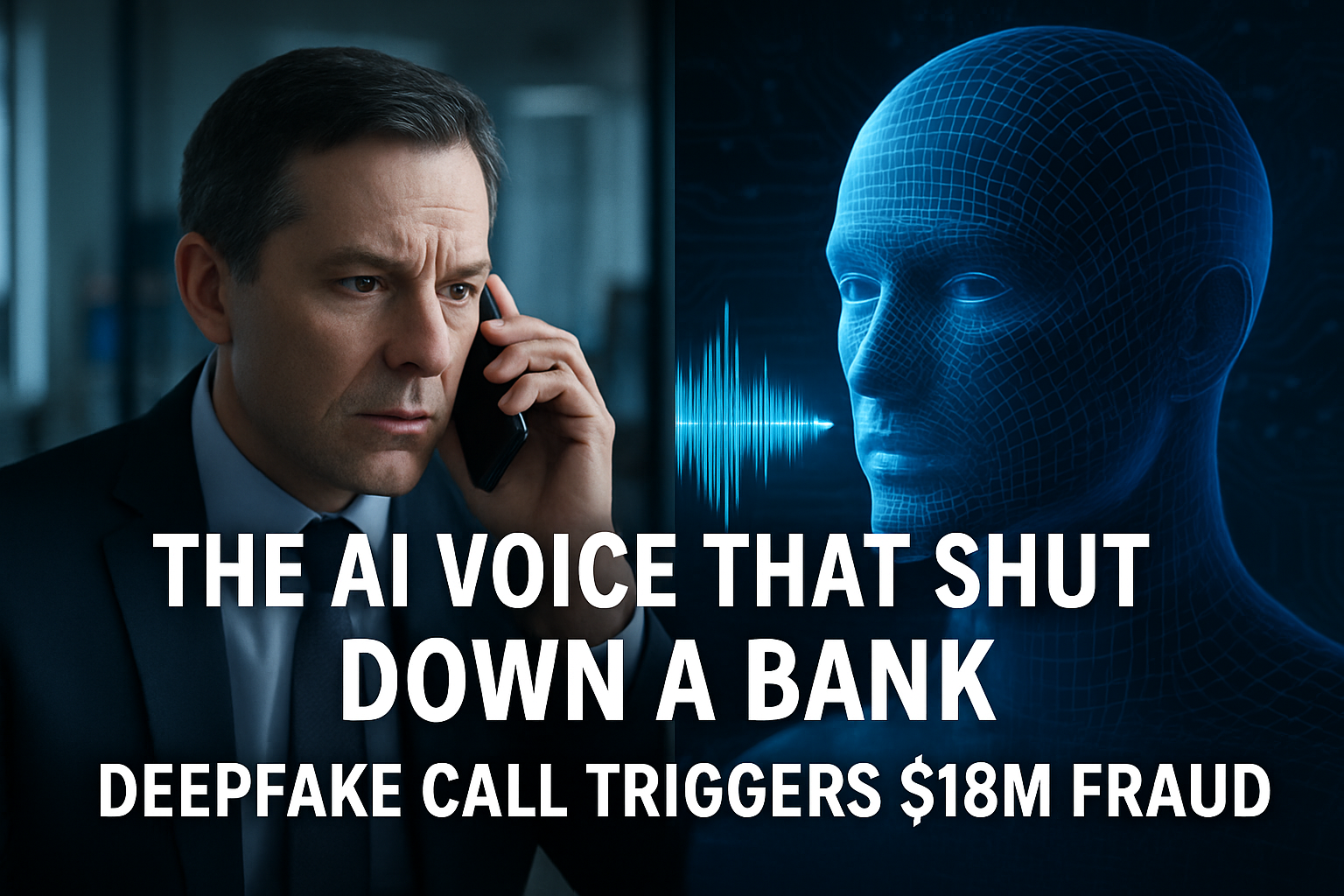
The AI Voice That Shut Down a Bank: Deepfake Call Triggers $18M Fraud
“It sounded just like the CEO — because it wasn’t human.”
In what is being called the most sophisticated AI-driven financial scam to date, a European investment bank lost $18 million USD last week — all due to a deepfake voice call.
According to insiders, a senior executive at the bank received a call from what sounded like their CEO, urgently requesting funds to be transferred to a “partner company” for an acquisition closing in under an hour.
There were no signs of phishing emails, malware, or hacked devices. Just a crystal-clear voice.
🎙️ When AI Mimics Authority
The chilling part? The voice wasn’t real. It was generated using AI voice cloning technology, trained on publicly available speeches, interviews, and earnings calls. The scammer used real-time AI speech synthesis to respond dynamically during the conversation, even answering unexpected questions convincingly.
The executive, unaware of the deception, authorized two high-value international transfers. By the time fraud detection systems raised red flags, it was too late. The money had disappeared through a web of crypto wallets and shell firms.
🧠 Deepfakes Go Corporate
We’ve seen deepfake videos used in politics and social media, but this incident marks a new phase in cybercrime — targeting the corporate world with AI-generated identities.
Cybersecurity firm DarkSignal, which is investigating the attack, believes the scammers may have also used AI to simulate background office noise and contextual phrasing based on past conversations.
“This is no longer science fiction. These tools are commercially available — some even free,” said Arvind Menon, CTO at DarkSignal.
🛡️ Can This Be Stopped?
Following the breach, the bank has temporarily disabled all voice-based approvals and now requires multi-party, biometric-authenticated verification for high-risk transactions.
Meanwhile, governments are being urged to classify synthetic identity fraud as a national security threat. The EU has accelerated its AI Act enforcement schedule, and the US SEC is expected to publish new enterprise guidance by September.
⚠️ What This Means for Everyone
This attack was precise, silent, and impossible to detect in real-time. It didn’t rely on software vulnerabilities — it exploited human trust in familiar voices.
As synthetic AI continues to advance, no one is immune — from CEOs to customer service agents. Businesses must adapt quickly, or risk becoming the next headline.
In the age of synthetic reality, hearing is no longer believing.
📬 Stay Updated!
Subscribe to receive the latest embedded & RTOS blog updates in your inbox.