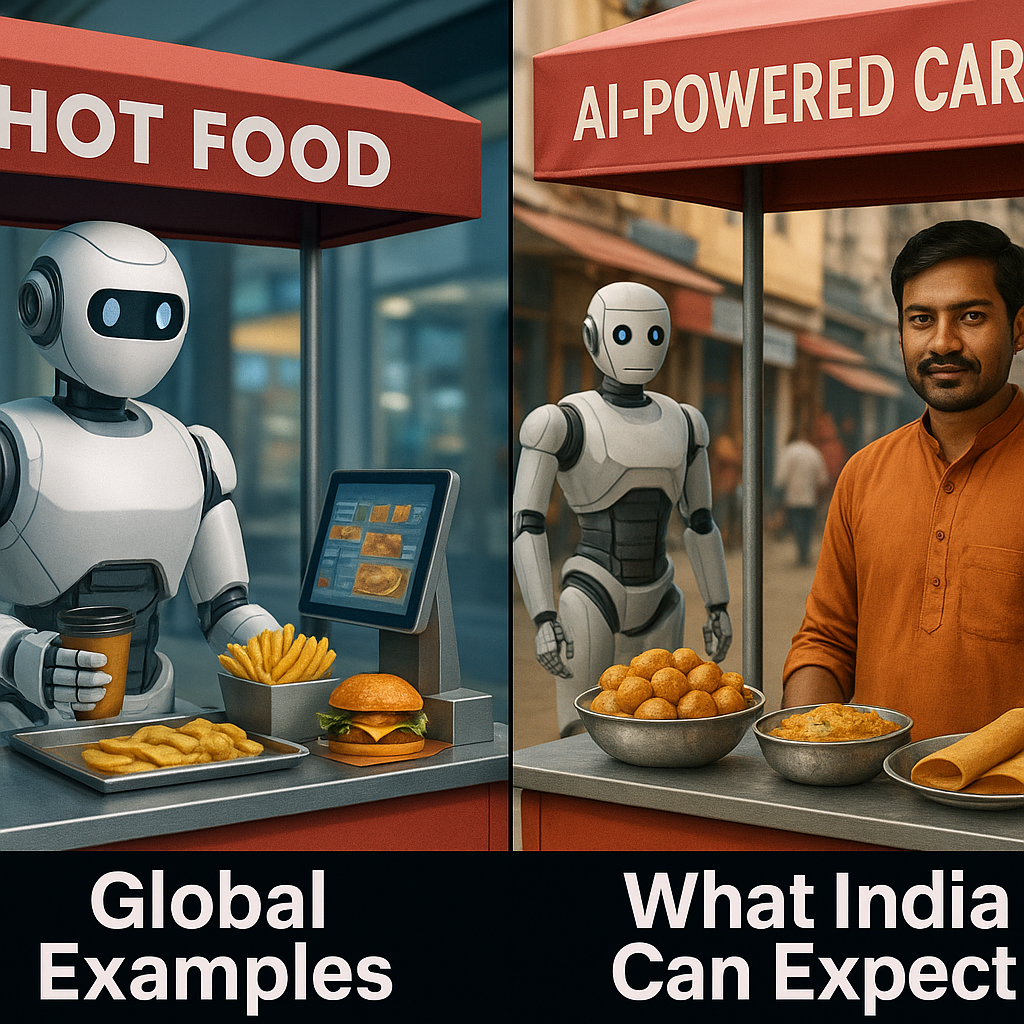
When Robots Sell Food: Global Examples and What India Can Expect
Robots are already serving food — but the future is not uniform. From automated coffee kiosks in North America to burger-making machines in the Bay Area and precision salad assemblers in Europe, the experiment of replacing repetitive kitchen tasks with machines has moved beyond labs to real streets and shopping malls.
Quick global tour
Companies and projects over the last few years proved the concept: robot baristas that pull espresso and hand over cups; automated burger makers that assemble and grill patties with repeatable precision; and food-assembly robots that portion, season, and plate snacks to consistent specs. Some players focused on speed and consistency to scale QSR operations; others targeted novelty and hygiene (contactless ordering became suddenly attractive after the pandemic). Meanwhile, logistics robots — floor delivery bots and sidewalk couriers — filled the last-mile gap inside malls and campuses.
These deployments taught two lessons: (1) automation shines where tasks are repetitive, predictable, and dangerous or dirty for humans; (2) customers value a mix of speed, reliability, and a story (why a robot is better than a human at this task).
Why India is ripe — and tricky
India’s food scene is wildly different. High density, low margins, and strong cultural attachment to street vendors create both opportunity and friction.
Opportunities
- Scale and footfall: Metro stations, tech parks, and malls offer concentrated demand where automated kiosks can recoup investment fast.
- Labor shortages in certain segments: Automated “mid-shift” kiosks can run where staff shortages hurt margins.
- Hygiene and consistency: Urban consumers pay for predictability and contactless service.
Challenges
- Cost sensitivity: Capital for robotic kiosks is high; products must be ultra-cheap to build or shared across locations.
- Local taste complexity: Indian dishes vary by region; mechanical recipes must be flexible or narrowly scoped (e.g., dosas vs. burgers).
- Regulation & permits: Street vending rules, food safety, and municipal permits vary widely between cities.
- Cultural acceptance: Many customers still prefer the human touch of a known vendor.
A practical route to adoption
A pragmatic path for India is hybrid automation: keep human vendors for complex, bespoke items and use machines for high-volume, repeatable products (coffee, packaged chaat, dosa batter dispensing, bottled drinks). Low-cost automation — modular dispensing units, simple vision sensors, and standardized recipe cartridges — can reduce build cost and accelerate deployment.
Additions that matter: cashless payments, real-time inventory alerts, and localized flavor profiles loaded as simple presets. For go-to-market, start in controlled environments (IT parks, airports, universities) where permits and maintenance are easier to manage.
Final thought
The future isn’t “robots replace all street vendors.” It’s robots extend capability — serving where consistency and speed matter while preserving the rich, human culture of India’s streets. The winners will be teams that design machines around Indian behaviors, not instead of them.
📬 Stay Updated!
Subscribe to receive the latest embedded & RTOS blog updates in your inbox.